China Top Bathroom Mat Manufacturers for Global Buyers
Choosing a Bathroom Mat for global markets is not a matter of color alone. Buyers need to assess absorbency, backing grip, drying time, edge finishing, and wash performance. A soft surface may feel inviting, yet remain damp for hours in a poorly ventilated bathroom. That difference matters.
Environmental microbiologist Dr. Charles Gerba studies hygiene in everyday environments. A relevant, paraphrased takeaway from his work is: “Keep bathroom textiles clean and let them dry thoroughly.” This is a paraphrase, not a verbatim quotation. It points buyers toward practical questions about care instructions, material performance, and product testing.
China’s manufacturing landscape includes suppliers with different materials, production capacities, customization options, and quality-control processes. Global buyers should compare product samples, request clear specifications, and check whether performance claims are supported by test data. Look closely at the underside. A backing that grips a dry tile may behave differently on wet stone. Small details can change daily use.
This guide introduces manufacturers and the factors buyers can evaluate before placing an order. It considers materials, construction, customization, communication, and shipment readiness. No supplier is right for every project. And a polished catalog is not proof of consistent quality. Buyers should verify what matters for their intended market, then confirm it with samples and documented checks. There is room for judgment here; product descriptions alone rarely tell the whole story.
Bathroom Mat Types, Materials, and Manufacturing Processes
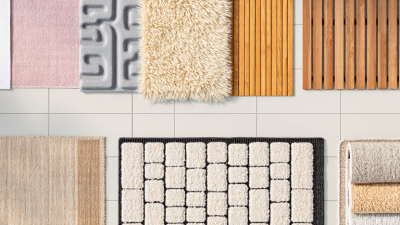
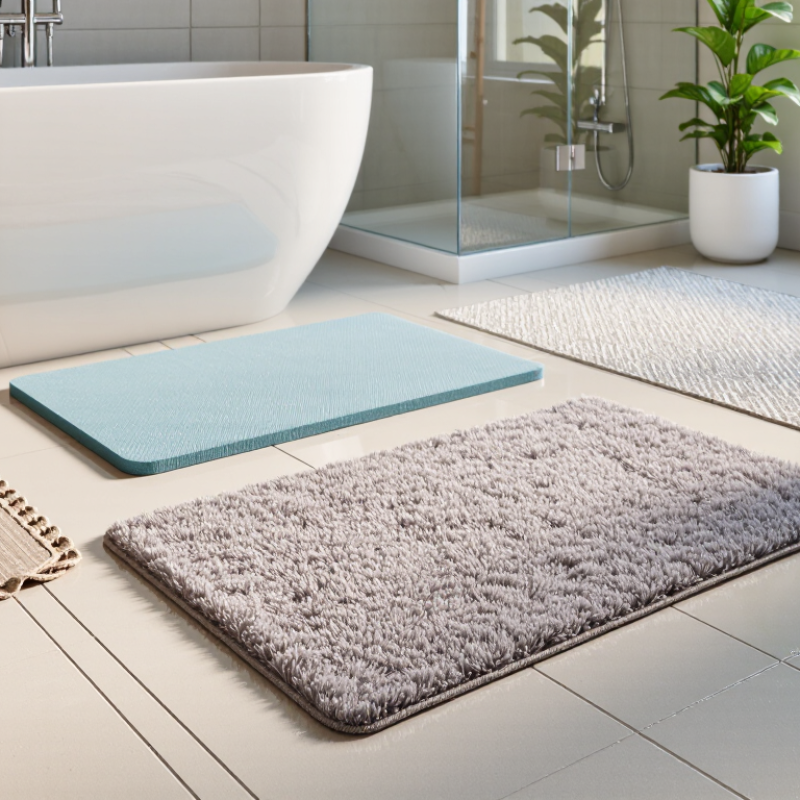
Bathroom mats differ in how they absorb water, feel underfoot, and dry after use. Looped cotton mats offer a familiar, washable surface, while microfiber piles feel plush and can wick moisture quickly. Flat-woven styles usually dry faster, though they may feel less cushioned on tile. Details matter. A mat’s backing can affect grip and floor compatibility; buyers should check its care instructions and test it on their own flooring.
Materials shape both performance and production. Cotton yarn is commonly woven or tufted, then trimmed and finished; microfiber is typically formed into dense pile and secured to a backing. Rubber or thermoplastic backing may be applied for traction, but heat, odor, and flexibility deserve inspection. Some mats use molded mineral-based surfaces for rapid surface drying, yet they can feel firm and require careful handling. Not always. During manufacturing, useful checks include pile consistency, edge binding, backing adhesion, and repeated wash testing. Ask suppliers for material specifications and sample batches, not just product photographs. A neat sample may not reveal how edges behave after several washes, and that point is easy to overlook.
Bathroom Mat Materials: Typical Moisture Regain
Cotton and viscose fibers typically regain more moisture from the air than polyester. Moisture regain is a standard textile measure based on dry fiber weight; it is not the same as a finished bath mat’s water-absorption capacity. Actual performance varies with yarn, pile construction, backing, and finishing.
China’s Bathroom Mat Manufacturing Hubs and Supplier Capabilities
China’s bathroom mat suppliers are spread across several manufacturing regions, with textile-oriented production found in areas such as Zhejiang, Jiangsu, and Guangdong. Their factories may handle tufting, weaving, cutting, edge binding, and packaging under one roof. Others focus on a narrower step and rely on nearby partners. That difference matters.
Materials range from cotton and microfiber to PVC-backed or other quick-drying constructions. A capable supplier should explain how pile height, backing, and finishing affect grip, drying time, and wash performance. Ask for samples in the intended size and color. Check the underside, seams, and edges—not just the soft surface. Small flaws show up quickly in a bathroom.
Production strength is only part of the picture. Buyers should ask how the factory checks dimensions, color consistency, shedding, and backing adhesion across batches. Request test details that match the product’s actual use, and confirm how defects are handled. Some suppliers provide clearer records than others. A polished sample can still hide uneven bulk production; that is easy to overlook. Where possible, compare a pre-production sample with goods from a completed order before making larger commitments.
Factory Quality Checks: AQL 2.5 Sampling and ISO 9001 Controls
China Top Bathroom Mat Manufacturers for Global Buyers
For global buyers, a bathroom mat should be checked beyond its color and softness. Ask the factory how it applies AQL 2.5 sampling to finished orders. This level is a sampling criterion, not a promise that exactly 2.5% of mats may be defective. The inspection plan should specify lot size, sample quantity, defect categories, and acceptance limits. Check measurements, backing adhesion, edge stitching, and visible stains under consistent lighting.
ISO 9001 controls can support consistent production through documented procedures, staff training, corrective actions, and traceable inspection records. They do not replace product-specific checks, and certification alone does not prove every shipment meets your requirements. Request recent inspection records and confirm the sampled goods come from the packed order.
A practical check might include measuring several mats, pulling gently at stitched edges, and inspecting backing after repeated flexing. Sampling can miss isolated defects. That limitation deserves attention, especially when colors or materials change between batches. A factory’s response to a failed check can be as informative as its pass rate.
Tips: Agree on defect definitions before production. Keep a signed reference sample, and specify who may inspect the goods. For repeat orders, compare records across batches. Small differences matter. Don’t rely on a certificate alone.
Textile Testing Conditions: ISO 139 at 20±2°C and 65±4% RH
China Top Bathroom Mat Manufacturers for Global Buyers
Bathroom mats can look stable while their fibers still respond to room humidity. ISO 139:2005 specifies a standard textile atmosphere of 20±2°C and 65±4% relative humidity for conditioning and testing. These are test conditions, not a product-quality grade. A mat tested after sitting in a damp warehouse may show different mass, thickness, or dimensional behavior than one conditioned properly. Small differences matter.
For reliable comparisons, suppliers should condition samples before measuring pile height, mass per area, and dimensional change. Record the room readings and conditioning time with each test result. A cold tile floor and a wet backing can distort a quick inspection. ISO 139 provides the shared reference; it does not guarantee that every laboratory follows it perfectly. That gap deserves attention. Global buyers can request test dates, laboratory conditions, and the applicable method alongside a sample report. For blended fibers or rubber-backed mats, ask whether the tested specimen represents the finished construction. It may not, and that is worth checking.
China Top Bathroom Mat Manufacturers for Global Buyers - Textile Testing Conditions: ISO 139 at 20±2°C and 65±4% RH
| Testing Dimension |
ISO 139 Reference Condition |
Equivalent Control Range |
Relevance to Bathroom Mat Testing |
| Standard reference |
ISO 139:2005, Textiles — Standard atmospheres for conditioning and testing |
Use the edition and any amendments specified by the test plan or contract. |
Provides standard atmospheric conditions for conditioning and testing textile specimens, including textile bathroom mats. |
| Atmosphere temperature |
20°C ± 2°C |
18°C to 22°C |
Record the test-area temperature so results from different test sessions can be compared under documented conditions. |
| Relative humidity |
65% ± 4% RH |
61% to 69% RH |
Moisture in textile fibres can be affected by ambient humidity, making this control relevant to properties such as mass and dimensional measurements. |
| Specimen conditioning |
Condition specimens in the specified standard atmosphere before testing. |
Maintain the specified temperature and relative humidity during conditioning. |
Apply the conditioning procedure and any equilibrium criteria required by the relevant product-test method. |
| Atmosphere monitoring |
Maintain and document the temperature and relative humidity of the conditioning or test area. |
Keep readings within 18–22°C and 61–69% RH when applying the stated ISO 139 conditions. |
Record actual readings and any deviations alongside the specimen identification and test results. |
| Test-method alignment |
ISO 139 specifies the textile atmosphere; it does not by itself define every bathroom-mat performance test. |
Follow the applicable method for each property being tested. |
Use the relevant method separately for measurements such as mass, dimensions, absorbency, or colourfastness. |
Global Buyer Checklist: Compliance, MOQ, Lead Time, and Shipping
When evaluating China-based bathroom mat manufacturers, request documents for the exact product construction, not a generic certificate. Check fiber content, colorfastness, backing materials, and chemical limits for your destination market. Ask for recent third-party test reports and confirm the product code matches your quotation. Requirements differ by market. A report for one backing material may not cover your final order.
Set the MOQ by size, color, and backing type. Custom colors may require separate dyeing runs. Confirm sample approval, production time, inspection dates, and rework arrangements in writing. Small orders can carry a higher unit cost. A low MOQ is not always flexible if the supplier must buy raw materials in bulk.
UNCTAD’s Review of Maritime Transport 2024 reports that over 80% of world trade by volume moves by sea. Compare shipping terms, quoted transit time, and booking deadlines; request carton dimensions, gross weight, and moisture-protection details. Still, plans slip. A factory schedule can look firm while a port booking changes, so leave buffer time before seasonal launches.